
Why Orthodox Reject Purgatory?

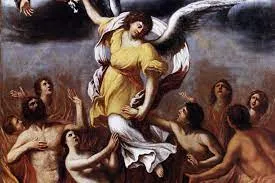
Catholic Teaching
In Catholic doctrine, Purgatory is a temporary state of purification after death. It is not hell, nor is it a second chance for the damned. Everyone in purgatory is already saved and destined for heaven, but they undergo a cleansing process to remove small sins or the temporal punishments due to sin.
- Defined as dogma at the Council of Florence (1439) and reaffirmed at the Council of Trent (1563).
- Catholic theology describes it as a “purging fire” (metaphorical or real) that prepares souls for heaven.
historical development of purgatory:
Middle Ages (6th–13th century)
- Gregory the Great (d. 604): first to clearly describe a “purgatorial fire.”
- He taught that souls of some Christians suffer after death to be purified before heaven.
Dialogues IV.40 "There was a deacon in Rome, a man who lived a seemingly good life, known for his zeal and devotion. However, after his death, he appeared in a vision to a friend, dressed in dark, scorched robes, standing amid flames."
When asked why he was suffering, the deacon explained:
“I am standing in fire for some light faults I did not cleanse in life. But thanks be to God, I am saved — not lost — and I will be delivered when Masses are offered for me.”
His suffering was not the punishment of the damned, but a purifying suffering, burning away the remnants of his un-repented minor sins.
- 11th–12th century: with the rise of penitential discipline, purgatory became systematized.
- Example: unfulfilled penances on earth were believed to continue after death.
- 12th–13th century scholastics (esp. St. Thomas Aquinas):
- Explained purgatory as a distinct state of souls after death.
- Became part of the Church’s theological system.
Biblical Roots (Catholic Interpretation)
- Judas Maccabeus offers sacrifices for fallen soldiers. Catholics interpret this as proof of prayer benefiting the dead.
- 1 Corinthians 3:13–15
- Paul speaks of one being “saved, but only as through fire.”
- Interpreted as post-mortem purification: the soul is saved, but undergoes painful cleansing.
- Catholic argument: if some sins cannot be forgiven after death, others must be.
- Since not all die perfectly pure, Catholics conclude purification after death is necessary.
Revelation 21:27
“Nothing unclean will ever enter [heaven].”
Matthew 12:32
“Whoever speaks against the Holy Spirit will not be forgiven, either in this age or in the age to come.”
2 Maccabees 12:42–45
“Therefore he made atonement for the dead, that they might be delivered from their sin.”
Formal Definition (15th–16th century)
- Council of Florence (1439): officially declared purgatory’s existence.
- Council of Trent (1563): reaffirmed it as dogma, condemning those who denied it.
The Medieval Context
By the 11th century, purgatory was no longer just a vague idea. It was being shaped into a system of penance, purification, and satisfaction:
- Sins were forgiven in confession, but penances (fasting, pilgrimages, etc.) remained.
- If those penances were unfinished, theologians believed they would continue after death in purgatory.
This opened the door for the Church to say: “If you do certain holy acts now, you can reduce or remove the penalties later.”
Urban II and the First Crusade (1095)
At the Council of Clermont (1095), Pope Urban II proclaimed the First Crusade. He promised:
- Those who went on the Crusade would receive full remission of all temporal punishment (a plenary indulgence).
- This meant that instead of long earthly penances, or purgatorial punishment after death — soldiers who died in battle for the Cross would go straight to heaven.
Why Was This Powerful?
- Fear of purgatory was real in medieval Europe. People believed they could spend hundreds or thousands of years in purgatory.
- The Church’s promise “Fight for Christ, and you will escape purgatory” This was a huge spiritual motivation.
- Many poor knights saw it as both religious salvation and social opportunity.
Expansion in Later Crusades
- After the First Crusade, indulgences were repeatedly offered for military campaigns:
- Against Muslims in the Holy Land.
- Against heretics in Europe (e.g., the Albigensian Crusade).
- Soldiers were told their participation could shorten or erase purgatorial punishments.
By the 13th century, indulgences became a normal part of recruiting armies.
Connection to the Reformation
- The abuse of indulgences (e.g., money collected for St. Peter’s Basilica in the 16th century) sparked Martin Luther’s protest in 1517.
- His 95 Theses attacked the idea that indulgences could buy release from purgatory.
- In Luther’s view, salvation was entirely God’s grace, not military service or payments.
The Coptic Orthodox Rejection of Purgatory H.H. Pope Shenouda III
Purgatory Contradicts the Doctrine of Atonement and Redemption
- Christ’s sacrifice is complete and sufficient. Humanity is incapable of satisfying divine justice. Only the Incarnation and death of Christ provide full atonement.
- If suffering in purgatory could satisfy God’s justice, then the Cross was unnecessary.
Scripture affirms full cleansing in Christ:
“The blood of Jesus Christ His Son cleanses us from all sin… He is faithful and just to forgive us our sins and to cleanse us from all unrighteousness.” (1 Jn 1:7–9)
“He is able to save to the uttermost those who come to God through Him.” (Heb 7:25)
Purgatory Contradicts the Good News of the Gospel
- If believers must still face tormenting flames after death, then the Savior’s work is incomplete and the “good news” is diminished.
- St. Paul longed “to depart and be with Christ” (Phil 1:23). This desire makes no sense if what awaits believers is purgatorial fire.
The angel declared at Christ’s birth:
“I bring you good tidings of great joy… a Savior is born to you.” (Lk 2:10–11)
Purgatory Contradicts God’s Justice
- Christ declared: “It is finished.” (Jn 19:30)
- If souls must still pay for sins in purgatory, then the price is paid twice — once by Christ, and again by human suffering.
- Furthermore, punishing the soul alone while the body, which participated in sin, remains in the grave contradicts God’s justice (cf. Gal 5:17).
St. Paul writes:
“You were bought at a price.” (1 Cor 6:20)
Purgatory Contradicts God’s Mercy
Cleansing occurs here on earth, through repentance and the work of the Holy Spirit, not through post-mortem flames.
“I will cleanse you from all your filthiness.” (Ezek 36:25)
True purification comes by grace, not torment:
“Purge me with hyssop, and I shall be clean; wash me, and I shall be whiter than snow.” (Ps 51:7)
“Though your sins are like scarlet, they shall be as white as snow.” (Is 1:18)
Purgatory Contradicts God’s Promises
Christ taught that forgiveness is free, not conditional upon post-death torment:
“He freely forgave them both.” (Lk 7:42)
God forgives and forgets sins:
“None of the transgressions which he has committed shall be remembered against him.” (Ezek 18:21–22)
“Having wiped out the handwriting of requirements… having nailed it to the cross.” (Col 2:14)
Purgatory Contradicts Scripture and Creates Problems
- The Right Thief: Christ promised, “Today you will be with Me in Paradise.” (Lk 23:43) — no mention of purgatory.
- The Last Day: “And thus we shall always be with the Lord.” (1 Thess 4:16–17). Are those alive at the Second Coming exempt from purgatory?
- Rich Man and Lazarus: Only two places — comfort and torment — separated by a great gulf (Lk 16:19–31). No third place.
- Judgment: The Bible speaks of one general judgment on the Last Day (Mt 16:27; 25:46; Jn 5:28–29; Rev 20:11–15), not a “particular judgment” sending most souls to purgatory.
Frequently Asked Questions ❓
Q1. Doesn’t 1 Cor 3:15 (“saved, but only as through fire”) prove purgatory?
Answer: No.
- The “fire” tests works, not souls (1 Cor 3:13).
- It is for testing, not torment.
- It happens on the Last Day, not before.
- It symbolizes difficulty in salvation (“scarcely saved” – 1 Pet 4:18), not purgatory flames.
Q2. What about Mt 12:32 (“forgiven in the age to come”)?
Answer: This refers to people wrongly excommunicated or unable to confess before death. Their forgiveness is declared in the age to come, not gained by purgatorial fire.
Q3. What about Mt 5:25–26 (“you will not get out until you have paid the last penny”)?
Answer: This passage is about reconciliation and judgment.
- Fathers interpret the “prison” as hell, not purgatory.
- In the parable of the unforgiving servant (Mt 18:24–34), the debtor is handed over to torturers until he pays — but he could never pay. This refers to eternal punishment, not temporary cleansing.
- The Coptic Orthodox Church rejects purgatory because it undermines:
- The sufficiency of Christ’s atonement (Heb 7:25; Rom 3:24).
- The justice and mercy of God (1 Cor 6:20; Ps 51:7; Is 1:18).
- The promises of Scripture (Lk 23:43; 1 Thess 4:17).